
Alex Hormozi: I Taught 116+ Salesmen My Closing Framework
Last updated: Jun 15, 2023
The video is about Alex Hormozi sharing his sales framework and experience in training salespeople and sales managers.
This video by Alex Hormozi was published on Jun 2, 2021.
Video length: 36:09.
In this video, Alex Hormozi talks about his experience teaching over 116 salespeople his closing framework.
He shares his background in sales, including doing 4,000 sales one-on-one in fitness, and how he trained sales teams in person and remotely.
He emphasizes the importance of simplicity in sales and offers to share his presentation on how he thinks about sales and scaling sales teams.
- Alex Hormozi is an entrepreneur, investor, and CEO of Acquisition.com.
- He has achieved a lot of success in his career and has been recognized by Russell Brunson from ClickFunnels as the best sales guy he knows.
- Alex Hormozi has a presentation about how he thinks about sales and scaling sales teams.
- Alex Hormozi has done 4,000 sales one-on-one in fitness, which gave him a lot of experience and practice.
- He believes that simplicity is what scales in sales.
- Alex Hormozi has experience in scaling sales teams.
- Implementing simple strategies can generate outsized returns.
- The presentation will cover the process for selling step by step.
- The sales framework has helped over a thousand clients hit $100,000 a year.
- The Closure Framework, The Conviction Framework, and The Scaling Framework are the three frameworks he teaches.
I Taught 116+ Salesmen My Closing Framework - YouTube

Introduction
- Alex Hormozi is an entrepreneur, investor, and CEO of Acquisition.com.
- He is known as the biggest internet marketer for fitness.
- He has achieved a lot of success in his career and has been recognized by Russell Brunson from ClickFunnels as the best sales guy he knows.
- Alex Hormozi has a presentation about how he thinks about sales and scaling sales teams.

Alex Hormozi's Sales Experience
- Alex Hormozi has done 4,000 sales one-on-one in fitness, which gave him a lot of experience and practice.
- He was taking 20 consults a day for four years, which helped him to develop his sales skills.
- He was really good at sales, so he did not hire a lot of salespeople and had his managers set appointments for him.
- Over time, he started training salespeople and sales managers and had a remote sales team.
- He has trained sales teams for in-person, phone, high ticket, and low ticket sales.

Simplicity in Sales
- Alex Hormozi believes that simplicity is what scales in sales.
- He has brought every sales product on the market and bought Grant Cardone and Balfour's stuff.
- He thinks there is a lot of merit and good stuff out there, but simplicity is what works best.
- He has a sales framework that he teaches to his sales teams.
- He believes that sales is about understanding the customer's problem and providing a solution.

I Taught 116+ Salesmen My Closing Framework - YouTube
Scaling Sales Teams
- Alex Hormozi has experience in scaling sales teams.
- He has flown out with his team to eight facilities every month and turned them around.
- He has brought his sales team in-house and had them do phone sales for high ticket items.
- He believes that scaling sales teams is about having a system and process in place.
- He has a framework for hiring, training, and managing salespeople.

The Importance of Simplicity in Sales
- Implementing simple strategies can generate outsized returns.
- Many salespeople are inundated with confusing information.
- A simple sales process can yield outsized returns.
- Efficiency in the conversion process can result in making more per customer than anyone else.
- Attaching a phone to a funnel has been a successful strategy.

The Sales Process
- The presentation will cover the process for selling step by step.
- There are two types of people: those under $100,000 a month and those over $100,000 a month.
- For those under $100,000 a month, the presentation will show how to never compete on price again.
- For those over $100,000 a month, the presentation will show how to scale a team to get to a million a month and beyond.
- The presentation will cover the actual selling process and the scaling of sales.

The Sales Framework's Success
- The sales framework has helped over a thousand clients hit $100,000 a year.
- Many of these clients were not naturally talented.
- The process works, and many people have achieved seven figures using it.
- The presenter has been able to donate 1.7 million to causes he cares about.
- The presenter's hero is Arnold Schwarzenegger, and he has been able to grow a friendship with him.

The Presenter's Experience
- The presenter started with only $5,000 and had to learn how to make money in one month.
- He built a funnel and was able to sell many people for free in the first two weeks.
- He had nine employees and felt like a badass.
- Facebook's slap happened, and his lead cost went up 5x overnight.
- His marketing was affected, and his money-making rain turned into a desert.

Background Story
- Alex Hormozi was losing money in his gym business and needed more leads.
- He learned from a friend to sell expensive stuff on the front end instead of trials.
- He went from losing money to making a ten to one return on the front end.
- He met someone who suggested he teach others how to do what he does.
- He created a marketing system that did 191 signups in 19 days and made $100,000 in sales.
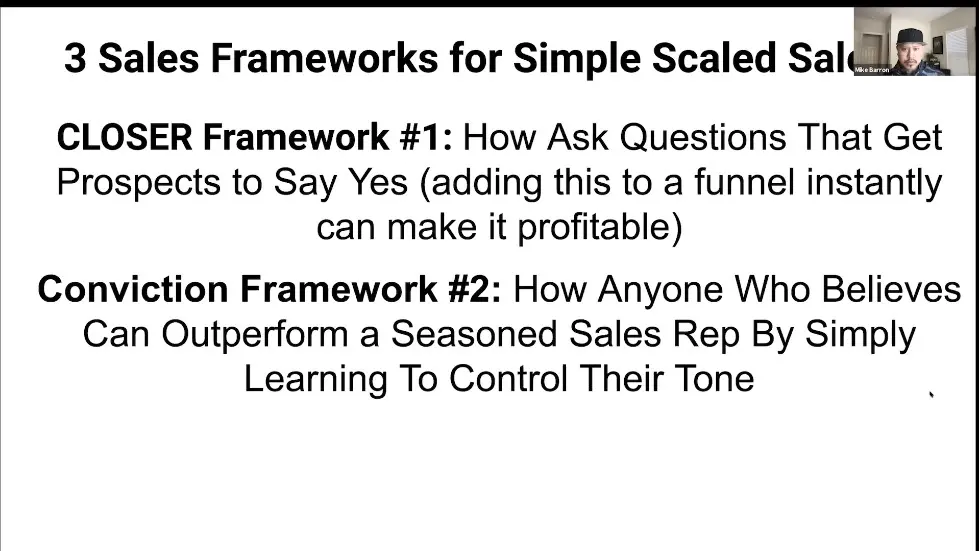
Three Frameworks
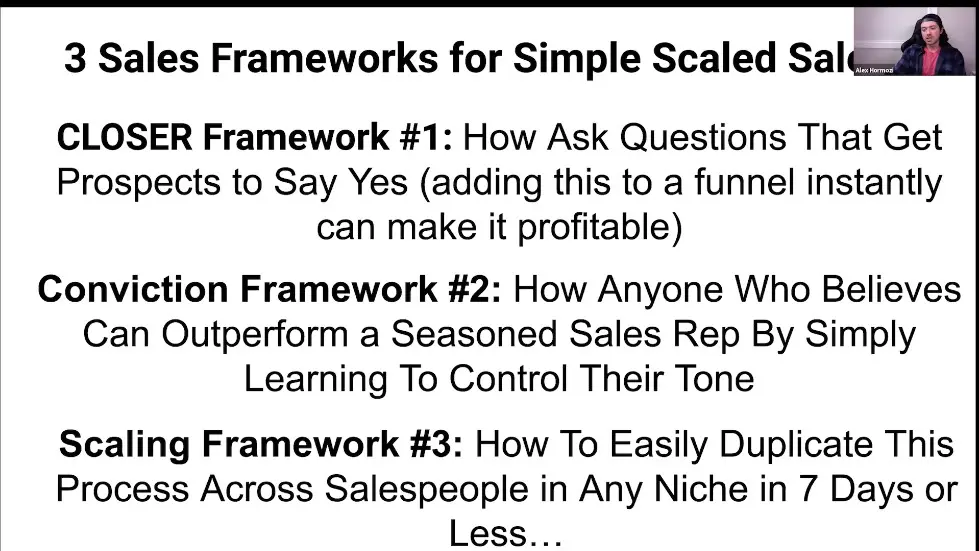
- The Closure Framework: a set of questions that get prospects to say yes.
- The Conviction Framework: learning to control tone to outperform seasoned sales reps.
- The Scaling Framework: duplicating the skill in other people to make more money.
The Closure Framework
- The acronym CLOSER: Clarify why the person is on the phone, Overview their past paid, Explain how to solve their problem, Explain away their concerns, Reinforce the decision.
- The process works for B2C and B2B and for high ticket sales of any price.
- The number one mistake salespeople make is not sticking to the process.
- The process is designed to help the prospect understand why they need the product or service.
- The process is designed to help the salesperson understand the prospect's needs and concerns.

The Conviction Framework
- Controlling tone is the key to convincing prospects to buy.
- Seasoned sales reps rely on experience, but anyone can learn to control tone.
- Controlling tone means being confident, calm, and assertive.
- Controlling tone means using pauses, inflection, and emphasis to convey meaning.
- Controlling tone means being able to handle objections and close the sale.

The Scaling Framework
- Duplicating the skill in other people is the key to scaling a business.
- Teaching others to sell is a more valuable skill than selling itself.
- Duplicating the skill means finding people who are coachable and motivated.
- Duplicating the skill means creating a system for training and feedback.
- Duplicating the skill means empowering others to make decisions and take ownership.

Clarifying Why They're There
- Consistently sell them on why they should take action.
- Clarifying why they're there.
- Helping them understand what they're doing there.
- Understanding what they want to solve.
- Understanding their goals and why they're important.

You have read 50% of the summary.
To read the other half, please enter your Name and Email. It's FREE.
You can unsubscribe anytime. By entering your email you agree to our Terms & Conditions and Privacy Policy.
Watch the video on YouTube:
I Taught 116+ Salesmen My Closing Framework - YouTube
Related summaries of videos:
- Alex Hormozi: 9 Beliefs That Built My Ultra High Net Worth Got Me To $121M By Age 31
- Alex Hormozi: When Money Stopped Mattering
- Alex Hormozi: What I Learned After Countless Failed Business Partnerships
- Alex Hormozi: How I Accidentally Made $17M when I was 28 Using “Leverage”
- Alex Hormozi: How I make $100,000/mo PASSIVE...I am the BANK
- Alex Hormozi: I spent $1,025,000 for this business tip...it paid off
- Alex Hormozi: How the rich avoid paying taxes...MY strategy - Part 1
- Alex Hormozi: The best way to invest your money...nobody will tell you this.
- Alex Hormozi: 1 SIMPLE mental technique that will SKYROCKET your sales...
- Alex Hormozi: How gurus lie about how much MONEY they make...I'm calling it out..
- Home
- About us
- Contact
- Book Summaries 0-9
- Book Summaries A
- Book Summaries B
- Book Summaries C
- Book Summaries D
- Book Summaries E
- Book Summaries F
- Book Summaries G
- Book Summaries H
- Book Summaries I
- Book Summaries J
- Book Summaries K
- Book Summaries L
- Book Summaries M
- Book Summaries N
- Book Summaries O
- Book Summaries P
- Book Summaries Q
- Book Summaries R
- Book Summaries S
- Book Summaries T
- Book Summaries U
- Book Summaries V
- Book Summaries W
- Book Summaries X
- Book Summaries Y
- Book Summaries Z
- Jay Shetty Podcast - Summaries
- Tom Bilyeu Impact Theory - Summaries
- Lex Fridman - Summaries
- Diary of a CEO - Summaries
- Alex Hormozi - Summaries
